What the quench medium actually has to do
Quenching is not simply "make it cold". The medium has one job: pull heat out of the austenitised part fast enough that carbon stays trapped and martensite forms, while doing as little violence to the part as possible. Every quenchant is a compromise between those two demands.
Heat leaves the surface in three stages. First a vapour blanket wraps the part and insulates it, so cooling is slow. Then the blanket collapses into nucleate boiling, where heat extraction peaks. Finally, once the surface drops below the boiling point of the medium, only convection remains and cooling slows again. The cooling rate is therefore never constant — and most soft spots trace back to a vapour blanket that clung to one area for too long.
Two variables matter as much as the medium itself: the hardenability of the grade and the section size. A boron steel such as 10B21, or a Cr-Mo grade such as SCM435, hardens comfortably in oil at fastener sections; a plain 0.45 % carbon steel of the same diameter may not reach the same numbers. A more severe medium only partly compensates for a grade that lacks hardenability.
Quench oil — the default for small parts
Quench oil is the working default for screws, nuts and bolts because its cooling rate suits steels that already have enough hardenability. Production baths run warm — typical industry guidance is roughly 40–80 °C depending on the oil and the work — because cold oil is viscous, will not flow into every gap in a bed of parts, and cools unevenly as a result.
Agitation is often the single largest variable on a real line. Oil flow is what makes the vapour blanket collapse quickly and, more importantly, collapse at the same moment across the whole load. Weaken the circulation and hardness scatter widens immediately, even though the furnace recipe never changed.
The advantage of oil is that it cools far more gently than water through the critical range, so thermal and transformation stresses stay lower: less distortion, lower crack risk. That is the direct reason thread roots and head fillets survive. The trade-offs are real: the grade must have adequate hardenability, oil must be washed off before tempering or plating, and oil ages — oxidation and water contamination quietly change its cooling curve, so bath condition belongs on a monitoring schedule.
Water and brine — the most severe, and the most dangerous
Water extracts heat far more aggressively than oil. Its place is with plain-carbon, low-hardenability steels in simple shapes, where nothing gentler will produce martensite at all.
The problem is that a threaded fastener is full of stress raisers: thread roots, the fillet under the head, recessed drives. Water-quenching a properly hardenable alloy fastener is the textbook recipe for quench cracking, and the cracks appear exactly where the stress concentrates — thread root or head fillet — sometimes hours after the parts have left the tank, as residual stress combines with retained austenite that is still transforming.
Brine behaves in a way that surprises people: the salt makes the vapour blanket break earlier and more evenly than plain water, so brine actually gives more uniform cooling and fewer soft spots. Severity is still high, though, and brine brings corrosion of both parts and tanks — which is why it is rare in high-count small-part work.
Polymer quenchants — tunable, if you control them
Polymer quenchants (commonly PAG types) are polymers dissolved in water that exploit inverse solubility: at the hot surface the polymer drops out of solution and forms a thin film that moderates heat extraction, then redissolves as the part cools.
The attraction is tunability. Severity depends on concentration, bath temperature and agitation, so a bath can be set somewhere between water and oil — with no smoke, no oil fire risk and easier washing afterwards.
The price is control. Concentration must be measured on a schedule (refractometer or viscosity) because drag-out on the parts dilutes the bath every day, and contamination or bacterial growth changes its behaviour. Without measurement and records the entire benefit disappears, because the same part will come out different next week. Polymer is also a poor fit where the next operation cannot tolerate water on the parts.
What about vacuum and gas quenching?
Vacuum furnaces with high-pressure gas quenching (nitrogen or helium) give a very clean surface and very low distortion. They suit tool steels and martensitic stainless grades — alloyed enough that a slower quench still forms martensite.
For ordinary fastener steels (medium-carbon, boron-treated or Cr-Mo in small sections), gas cooling is usually not fast enough to reach full hardness at a competitive cost. That is why bulk fastener work stays with oil.
Why a small fastener is quenched the way it is
Small parts arrive as a mass — thousands at a time. Their sections are thin and cool quickly anyway, so the dominant risks are not "not hard enough" but distortion, parts touching each other, parts nesting or tangling, and uniformity across the load.
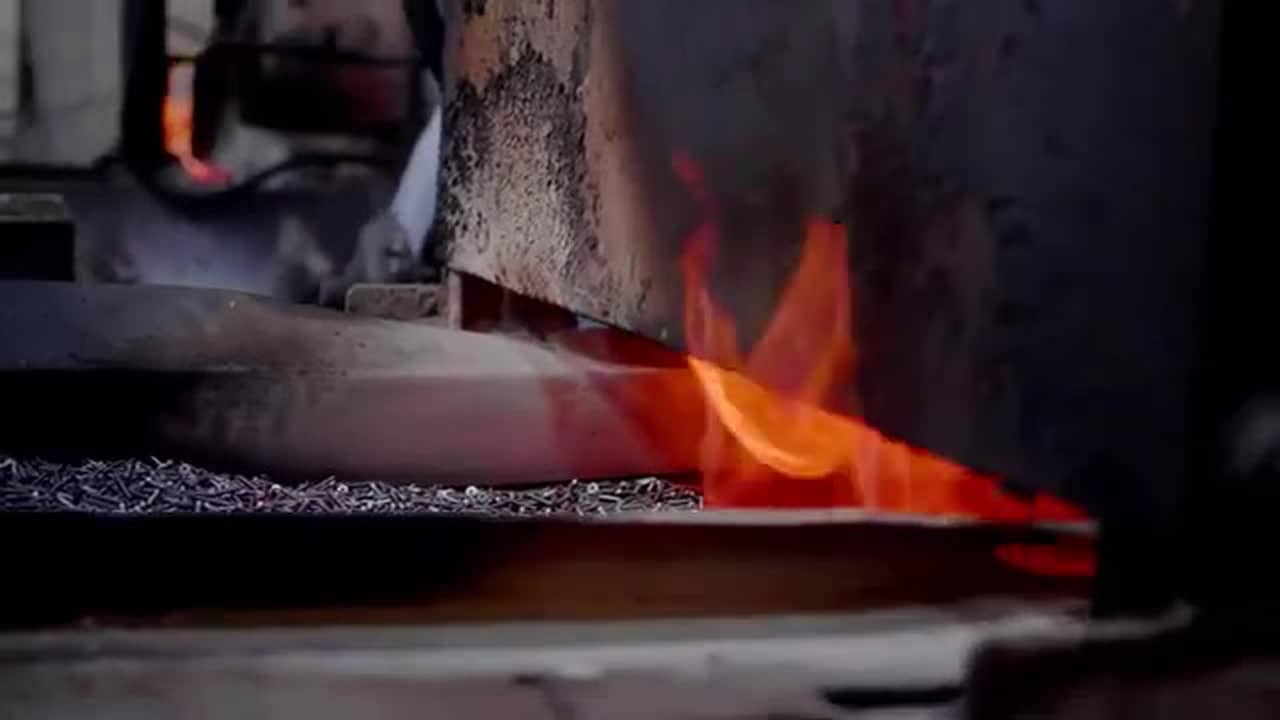
That drives the recipe: a grade with sufficient hardenability, plus a temperature-controlled and agitated oil, plus a load spread thin enough for oil to reach every piece. It is exactly why a continuous line drops a thin, moving bed of parts into a circulating oil bath instead of plunging one densely packed basket.
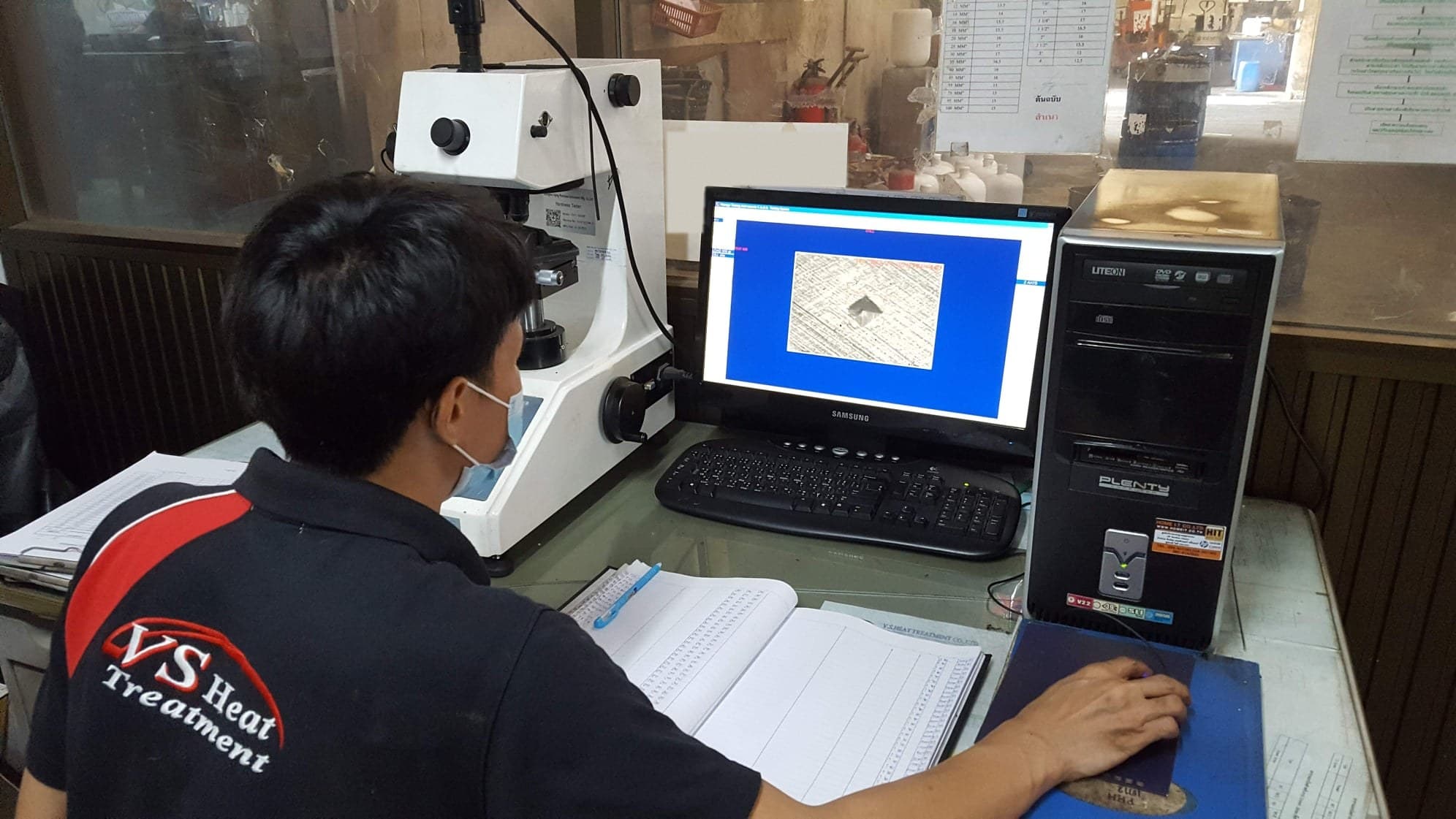
Verification happens at the end: sample hardness on every lot. When the readings scatter, work through the causes in order — soft spots from a persistent vapour blanket or part-to-part contact, surface decarburization from furnace atmosphere, or a grade with less hardenability than assumed. Where surface readings are ambiguous, the reference method is a cross-section micro-Vickers traverse along the lines of ISO 6507.
How V.S. Heat Treatment runs it, and what to tell us
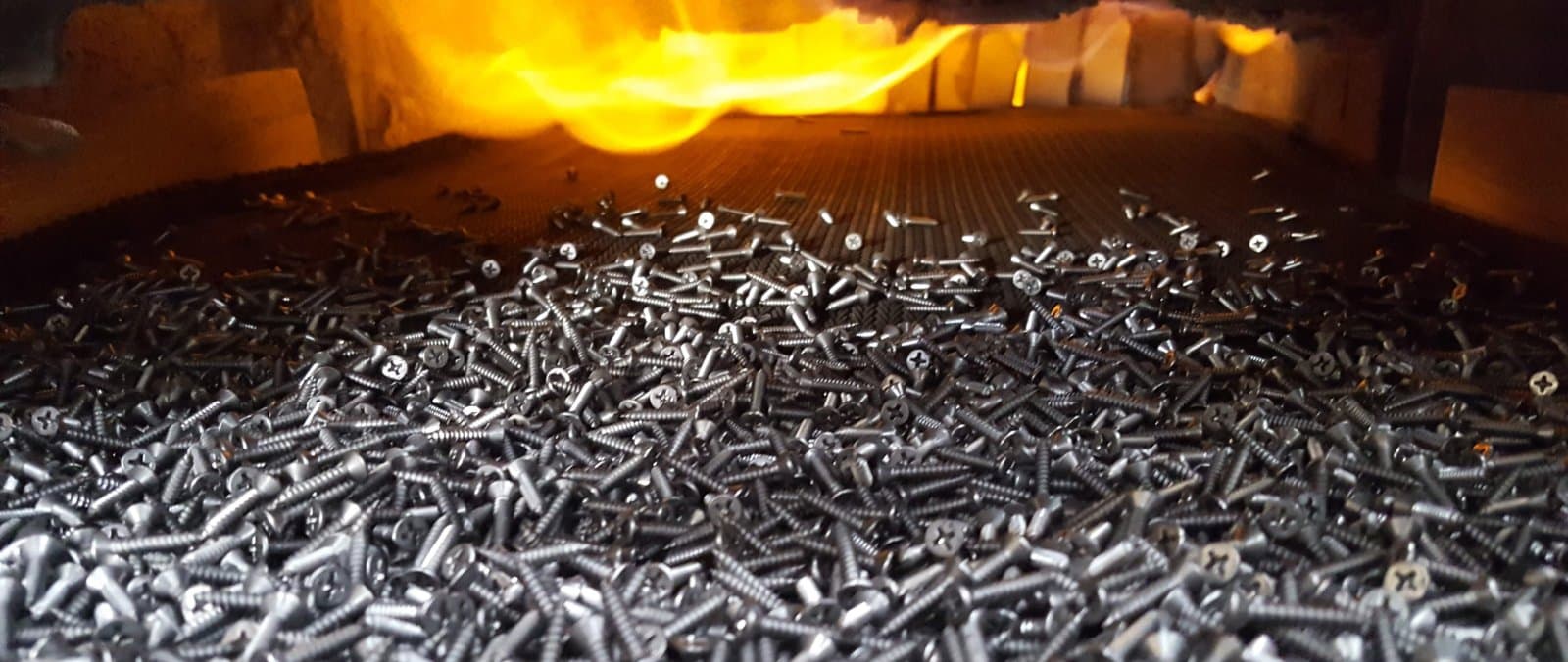
Our hardening line is a continuous mesh-belt furnace under an endothermic gas atmosphere, quenching into temperature-controlled quench oil, followed by tempering in a dedicated furnace. It is built for screws, nuts, bolts, washers, pins and springs in bulk — not for large parts. Plant capacity is 2,000 tons per month.
What lets us answer precisely: the grade and section size, the target hardness band and where it is measured, the thread tolerance class, any straightness or flatness requirement, and whether the parts will be plated afterwards — that last point decides whether hydrogen-relief baking applies.
Plainly stated: our small-parts line quenches in oil. We do not run a water quench tank for fastener work, and we do not operate a salt bath for austempering. If a drawing specifies a different medium, say so with the enquiry so we can give you a straight answer immediately. Every lot ships with hardness readings from our own lab under an ISO 9001:2015 quality system, and we reply to quotes within 24 hours.
FAQ
Oil quenching or water quenching — which is better for bolts?+
For hardenable fastener grades, oil wins in almost every case: it reaches the specified hardness with far less distortion and much lower crack risk. Water belongs with plain-carbon, low-hardenability steels in simple shapes.
Does quench oil temperature really matter?+
Yes. Oil that is too cold is viscous and cannot reach through a bed of parts, which widens hardness scatter; oil above its working range extracts heat more slowly and raises safety concerns. Bath temperature and agitation are controlled process parameters, not incidental conditions.
Can polymer quenchant simply replace oil?+
It is not a drop-in swap. Polymer severity depends on concentration, temperature and agitation; without measurement and records the same part will come out differently. Prove it on a trial lot with comparative hardness readings first.
My parts came out with soft patches — is that the quenchant?+
Often, yes: a vapour blanket that persisted, parts touching so the medium could not reach the contact area, or a load packed too densely. Before concluding, check the surface for decarburization and confirm the grade — both produce similar-looking hardness readings.
Standards and references
Free Engineering Tools
- Hardness Converter HRC ↔ HV ↔ HB
- Which Steel Grades Harden — and How Far
- Fastener Weight: pcs ↔ kg
- Finishing Specification Builder for Purchasing and QC
- Salt Spray Test Plan Builder
- Coating thickness → thread fit (GO/NO-GO)
- Hydrogen Embrittlement — is baking required?
- Bolt Tightening Torque & Proof Load
- Thread Engagement Length
- Bolt Size Estimator (from load)
- Bolt Property Class — Mechanical Properties (ISO 898-1)
What this article covers at our plant
Related comparison guides
- Case hardening vs Through hardeningCase hardening vs through hardening: which one for screws and bolts?
- Annealing vs Tempering vs NormalizingAnnealing vs tempering vs normalizing: which one does your part need?
- Quenching vs TemperingQuenching vs tempering: two halves of one process
- Carburising vs NitridingCarburising vs nitriding: what a screw, nut or bolt actually gets
- Carbonitriding vs CarburizingCarbonitriding vs carburizing: which case-hardening for fasteners?
- S45C vs SCM440S45C vs SCM440: which steel should you harden?
- SCM435 vs SCM440SCM435 vs SCM440: one alloy step apart, and it shows
- Grade 8.8 vs Grade 10.9 vs Grade 12.9Grade 8.8 vs 10.9 vs 12.9 bolts: what actually differs?
- Class 10.9 vs Class 12.9Class 10.9 vs 12.9: what you gain, and what you take on
Technical content review
Reviewed by the V.S. Heat Treatment QA and production team—heat-treatment and finishing operations since 1994 under an ISO 9001:2015 quality system.
View evidence and report format