Two furnace architectures
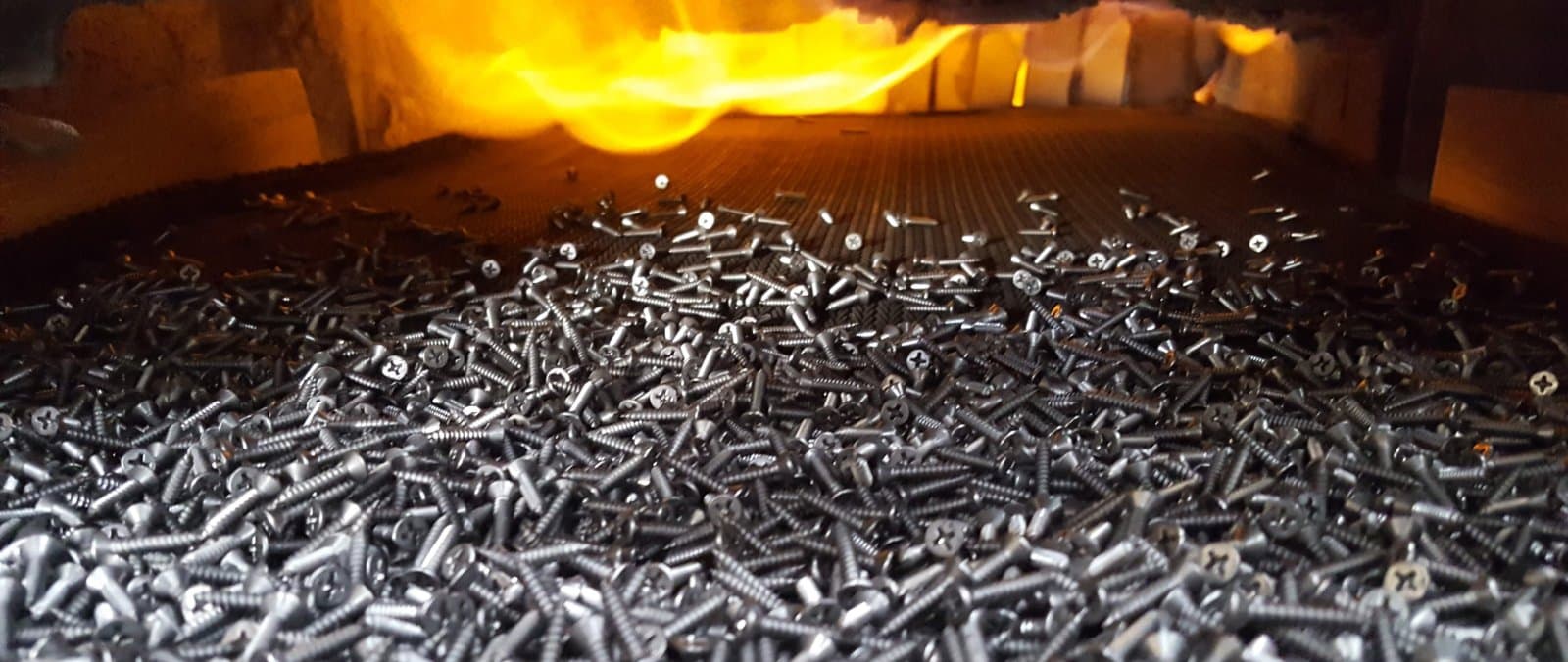
A continuous mesh-belt furnace feeds parts onto a woven alloy belt that carries them through preheat, atmosphere-controlled and austenitising zones in sequence. At the exit the parts drop straight into the quench oil, then run on through washing and a continuous tempering furnace. The controlling variables are belt speed, feed rate, zone temperatures and atmosphere, and the whole line operates at steady state.
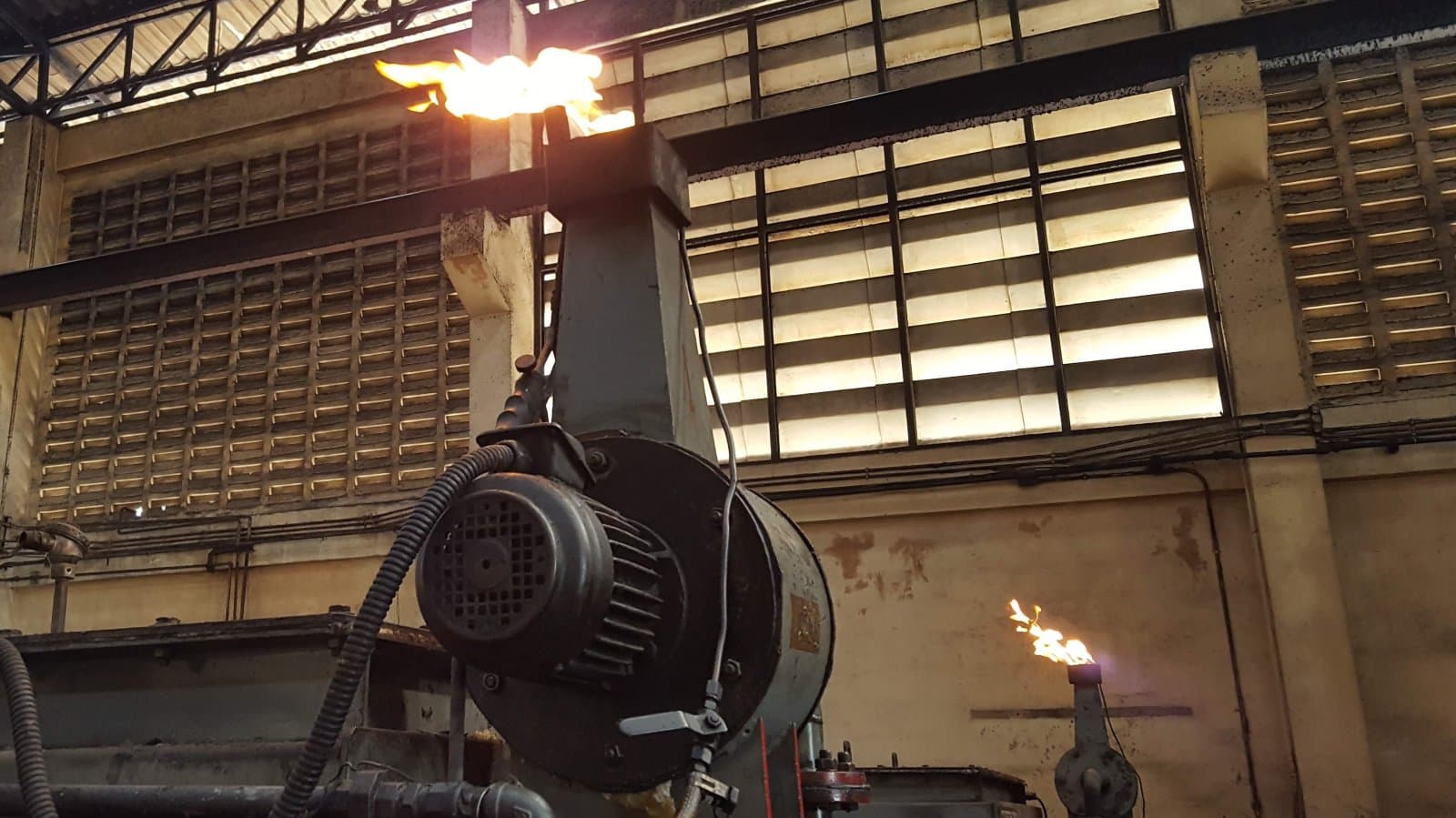
A batch furnace (often an integral- or sealed-quench chamber type) takes a loaded basket into the chamber, closes the door and puts the whole load through one cycle — heat, soak, then quench into the oil tank attached to the furnace — after which the load is tempered in a separate furnace. The controlling variable is the time-temperature programme of that cycle.
Neither is "better" in the abstract. They solve different problems, and choosing the wrong one always shows up either as scatter or as cost.
Uniformity — but two different kinds of it
On a belt, every part sees the same time-temperature history because belt speed is fixed. The remaining variation comes from bed depth and from parts lying on top of each other, which means the real control is feed rate per belt width, not just the zone setpoint.
In a batch furnace the whole load runs one cycle, but the load does not experience one condition. A deep basket has gradients between edge and centre, the placement of the load thermocouple genuinely affects the result, and every door opening costs atmosphere and temperature recovery time.
One point often missed: a continuous line holds its gas atmosphere for the whole shift, while a batch furnace re-establishes atmosphere every load. Controlling decarburization on thread crests — the damage that directly destroys fastener strength — is therefore easier on a line that simply keeps running.
Part size and shape decide a lot of it
A belt is limited by belt width, the height available under the muffle, and the weight the belt can carry per unit area. Its natural work is a large quantity of small parts spread in a shallow bed.
Long, heavy or bulky parts, parts that need fixturing, and parts that must not touch each other belong in a batch furnace, where they can be arranged and positioned in a basket.
A caution specific to belt work: very thin parts, fine wire and parts that hook into each other (springs, clips, retaining rings) demand attention to belt mesh size and feeding, or they fall through the mesh or arrive as a tangled mass.
Process capability and recipe flexibility
Batch furnaces win where long soaks are needed: carburising to a deep case, vacuum processes, or frequent recipe changes on small lots. Changing a recipe in a batch furnace means changing a programme, not resetting an entire line.
Continuous lines win where the same recipe runs for hours or days: lower energy per kilogram at steady state, no per-load ramp-up, a stable atmosphere, and washing and tempering in line without re-handling the parts.
Put simply: a batch furnace buys flexibility with cycle time, and a continuous line buys cost per kilogram and repeatability by giving flexibility up.
Why bulk screws, nuts and bolts run continuous
Four straightforward reasons: (1) small thin sections reach temperature quickly, so continuous flow does not short-change them; (2) the parts arrive tens or hundreds of thousands at a time, so cost per kilogram is the whole game; (3) loading is measured as weight per unit time, which belt speed controls directly; (4) a stable atmosphere held all shift protects thread crests from decarburization, the failure mode that most directly destroys the strength of a fastener.
The limits are worth knowing too: parts that tangle, parts too long to lie flat, and any requirement for a genuinely deep case are not mesh-belt work.
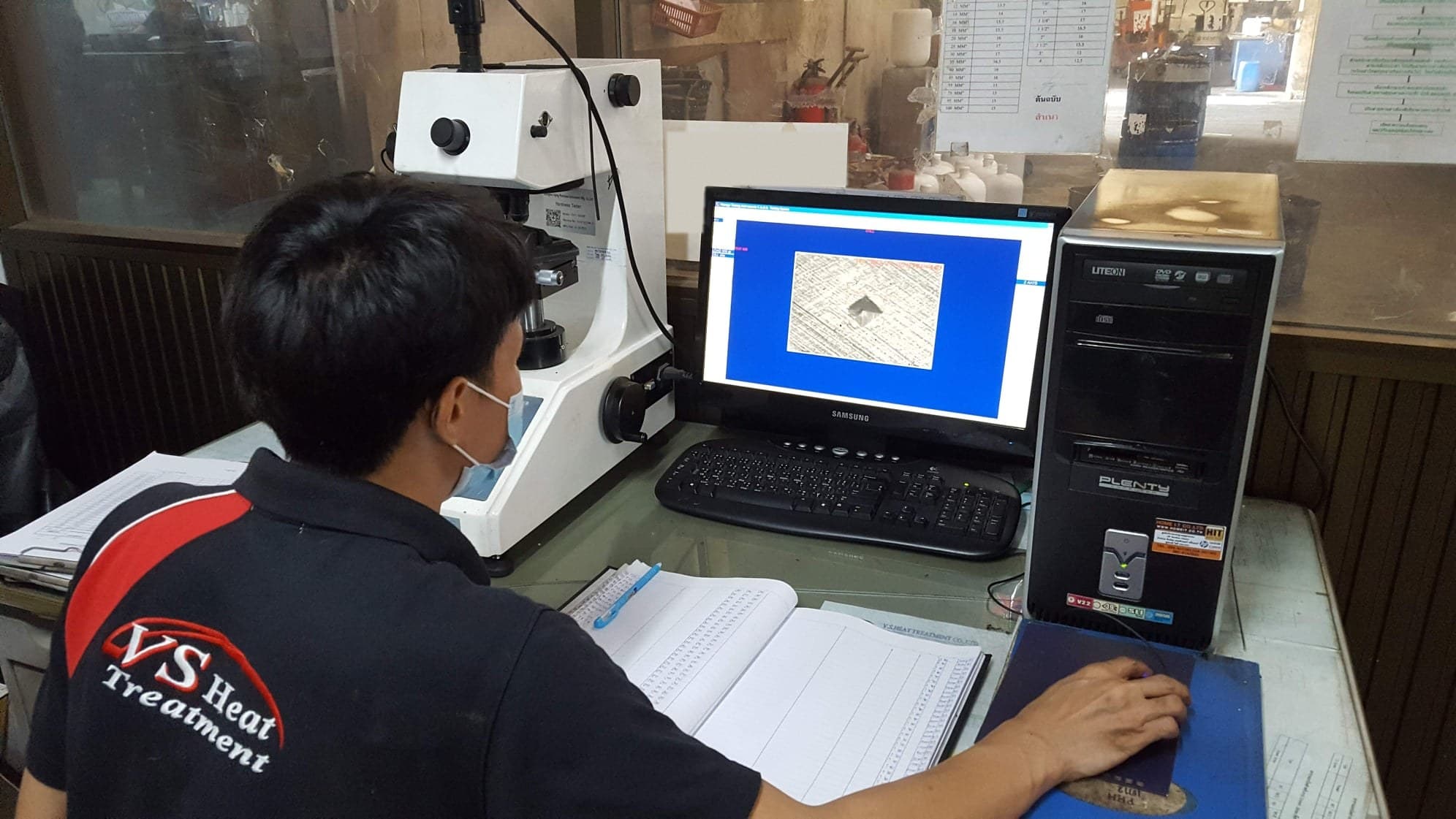
Whichever architecture is used, the proof of control is the same evidence: zone or cycle temperature records, atmosphere control, sampled hardness per lot, and microstructure examination when the specification calls for it.
The V.S. Heat Treatment line
We run a continuous mesh-belt furnace in the region of 750–950 °C under an endothermic gas atmosphere, quenching into temperature-controlled oil and tempering in a dedicated furnace. It is built for screws, nuts, bolts, washers, pins, springs and anchor bolts in bulk.
If your part is too large to pass through the line, or the drawing calls for a case depth beyond what a continuous line does well, we will say so rather than waste your time and ours.
Plant capacity is 2,000 tons per month, every lot carries hardness readings from our own laboratory, our quality system is ISO 9001:2015, and we reply to quotes within 24 hours.
FAQ
Which furnace gives more consistent hardness?+
Control matters more than architecture, but for high-count small parts a steady-state continuous line usually gives tighter lot-to-lot consistency, because every part sees the same profile and the atmosphere is not re-established each cycle.
Can a mesh-belt line carburise to a deep case?+
Mesh-belt carburising is best suited to light and medium cases, because soak time is set by furnace length and belt speed. A genuinely deep case needs the long soak a batch furnace provides — so state the target case depth with your enquiry.
What is a sealed quench furnace?+
A batch furnace with the quench tank built into it and sealed against the outside air, so the load transfers from the heating chamber into the oil without meeting the atmosphere — limiting oxidation and decarburization during transfer.
Is a batch furnace inferior?+
No, it is a different job. Batch equipment excels at large parts, fixtured parts, frequently changing recipes and long soaks; continuous lines excel at high volume on a stable, repeatable recipe.
Standards and references
Free Engineering Tools
- Hardness Converter HRC ↔ HV ↔ HB
- Which Steel Grades Harden — and How Far
- Fastener Weight: pcs ↔ kg
- Finishing Specification Builder for Purchasing and QC
- Salt Spray Test Plan Builder
- Coating thickness → thread fit (GO/NO-GO)
- Hydrogen Embrittlement — is baking required?
- Bolt Tightening Torque & Proof Load
- Thread Engagement Length
- Bolt Size Estimator (from load)
- Bolt Property Class — Mechanical Properties (ISO 898-1)
What this article covers at our plant
Related comparison guides
- Case hardening vs Through hardeningCase hardening vs through hardening: which one for screws and bolts?
- Annealing vs Tempering vs NormalizingAnnealing vs tempering vs normalizing: which one does your part need?
- Quenching vs TemperingQuenching vs tempering: two halves of one process
- Carburising vs NitridingCarburising vs nitriding: what a screw, nut or bolt actually gets
- Carbonitriding vs CarburizingCarbonitriding vs carburizing: which case-hardening for fasteners?
- S45C vs SCM440S45C vs SCM440: which steel should you harden?
- SCM435 vs SCM440SCM435 vs SCM440: one alloy step apart, and it shows
- Grade 8.8 vs Grade 10.9 vs Grade 12.9Grade 8.8 vs 10.9 vs 12.9 bolts: what actually differs?
- Class 10.9 vs Class 12.9Class 10.9 vs 12.9: what you gain, and what you take on
Technical content review
Reviewed by the V.S. Heat Treatment QA and production team—heat-treatment and finishing operations since 1994 under an ISO 9001:2015 quality system.
View evidence and report format