Start with your specification, not with a supplier list
Most failed sourcing exercises fail at the enquiry. If the request says "zinc plated, must not rust", every supplier guesses differently and the quotes that come back cannot be compared, because each one is answering a different specification.
Write the requirement out first: base material and grade; the condition of the part (heat treated or not, property class or hardness); the coating and its thickness together with the measuring location; passivate type and colour; seal or topcoat; the hydrogen-relief bake requirement; the thread tolerance class after coating; lot size and packing; and the test evidence you require with delivery.
Send that same document to everyone and the prices become genuinely comparable — and how each supplier responds to it is the first real data point you collect about them.
Learn to read a coating designation
A coating designation is a chain of fields: base metal → coating metal → thickness → passivation type → seal or topcoat. What each field means depends on the standard family the drawing invokes: ISO 4042 for electroplated coating systems on fasteners, ISO 2081 / ASTM B633 for zinc on steel generally, and ISO 19598 for hexavalent-chromium-free systems — plus, in the automotive world, customer-specific standards layered on top.
Three things buyers routinely miss: (1) a thickness figure means little without a measuring location, and without saying whether it is a minimum local value or an average; (2) the colour name is not the protection level — the type of conversion film is what carries the corrosion classification; (3) for threaded parts the coating must live inside the thread tolerance, so a coating that is "safely thick" can be a coating that will not assemble.
This article explains these in our own words and does not reproduce them. Read the published documents themselves and confirm the interpretation with your design authority.
The documents to require — and what each actually proves
- The quality-system certificate — read the scope statement, not the logo. Does the scope cover the processes you are buying, at the site that will run them? Check the certificate number, the issuing body and the validity dates.
- A sample test report in the format you will receive in production — it should identify the lot and the part, the specification referenced, the measurement method and instrument, the result, and who signed it.
- Calibration evidence for the instruments that generate your numbers (hardness testers, XRF, thickness gauges): traceability, calibration interval, last calibration date.
- Substance declarations — Cr(VI)-free, RoHS and REACH statements covering the passivation and any sealer actually used on your parts.
- Process control records — how often baths are analysed, bake records with real time stamps, furnace temperature records.
- Environmental and permitting standing — ask how the site handles wastewater and which permits apply. An unanswerable question here is a supply-continuity risk, not merely a paperwork gap.
Decide one thing up front: do you need the supplier’s in-house laboratory report or an accredited third-party test report? They differ in cost and lead time. If your specification requires the latter, say so in the enquiry rather than discovering it at first delivery.
Questions for the plant visit — and what a good answer sounds like
- Traceability — how is my lot identified from goods-in to packing? If two customers’ identical M8 bolts arrive on the same day, what keeps them apart? A good answer points at a physical tag or lot-number system, not at someone’s memory.
- Process control — who is allowed to change a recipe, and where is that recorded? How often are baths analysed, and by whom? What triggers a bath correction?
- High-strength parts — which parts get a relief bake, who decides, when does the clock start relative to plating, and where is the record kept?
- Inspection — what is measured, at what sample size, with which instrument, at which point on the part, and who calibrates that instrument?
- Nonconformance — what happens to a failed lot: strip and re-plate, rework, or scrap? Who informs me, and within how many hours?
- Continuity — shift pattern, plant shutdown calendar, and what happens if a line goes down unexpectedly.
- Language and experience — do they support your language (Japanese/Chinese/Korean/English) so specs are clear? Do they have experience with automotive/electronics maker standards? Can they hold a hardness (HRC) band and a salt-spray rating to your spec?
- Logistics and packing — how are the parts packed, how is lot mixing prevented, and do they pick up from and deliver to my industrial estate, and on what cycle?
A note that is fair to everyone: a supplier who asks you many questions — grade, hardness, thread class, what the part does in service — is usually the safer one. Instant agreement to everything, with no questions at all, is a warning sign rather than confidence.
What a trial lot must prove
The point of a trial lot is to prove the production process, not a carefully hand-finished sample. Say so explicitly on the order: the trial must run through the normal line.
Design it to answer everything at once. Use real parts from the drawing, ideally from one material lot, and keep untreated parts as a reference. Measure thickness both at the specified location and at the worst-case location — thread root, recess, or inside a nut thread. Check thread fit after coating with go/no-go gauges. Sample from the front, middle and back of the barrel or basket, not from the top of the box.
Verify the hydrogen-relief bake record, including the start time relative to plating. If you use salt spray, use it as a comparative test: it screens process consistency and catches gross errors; it is not a prediction of service life in the field.
Most important of all: agree in numbers what "pass" means before the parts are made, and require the report in exactly the format you will receive in production.
Signals worth a second look — and terms to agree in advance
Signals to probe further (not verdicts, but places to keep asking): a quotation that asks you nothing; a thickness quoted without a measuring location; salt-spray hours offered as if they were a guarantee of service life; no clear answer on bake timing for high-strength parts; no written rule for what happens to a rejected lot; refusal to accept a trial sample; dodging questions about Cr3+/RoHS; and reluctance to say which steps, if any, are subcontracted to a third party. Subcontracting is normal — not telling the buyer is the problem.
Terms worth agreeing before the first production order: the definition of a "lot"; retained samples; notification when a process or chemistry changes; the pricing basis (bulk small-parts work in Thailand is normally quoted per kilogram or per ton); packaging; and how rework is charged.
Finally, do not judge on price per kilogram alone. The real cost of finishing is price plus scrap plus the sorting you end up doing at your own line plus the hours lost arguing about documentation.
Apply this checklist to us as well
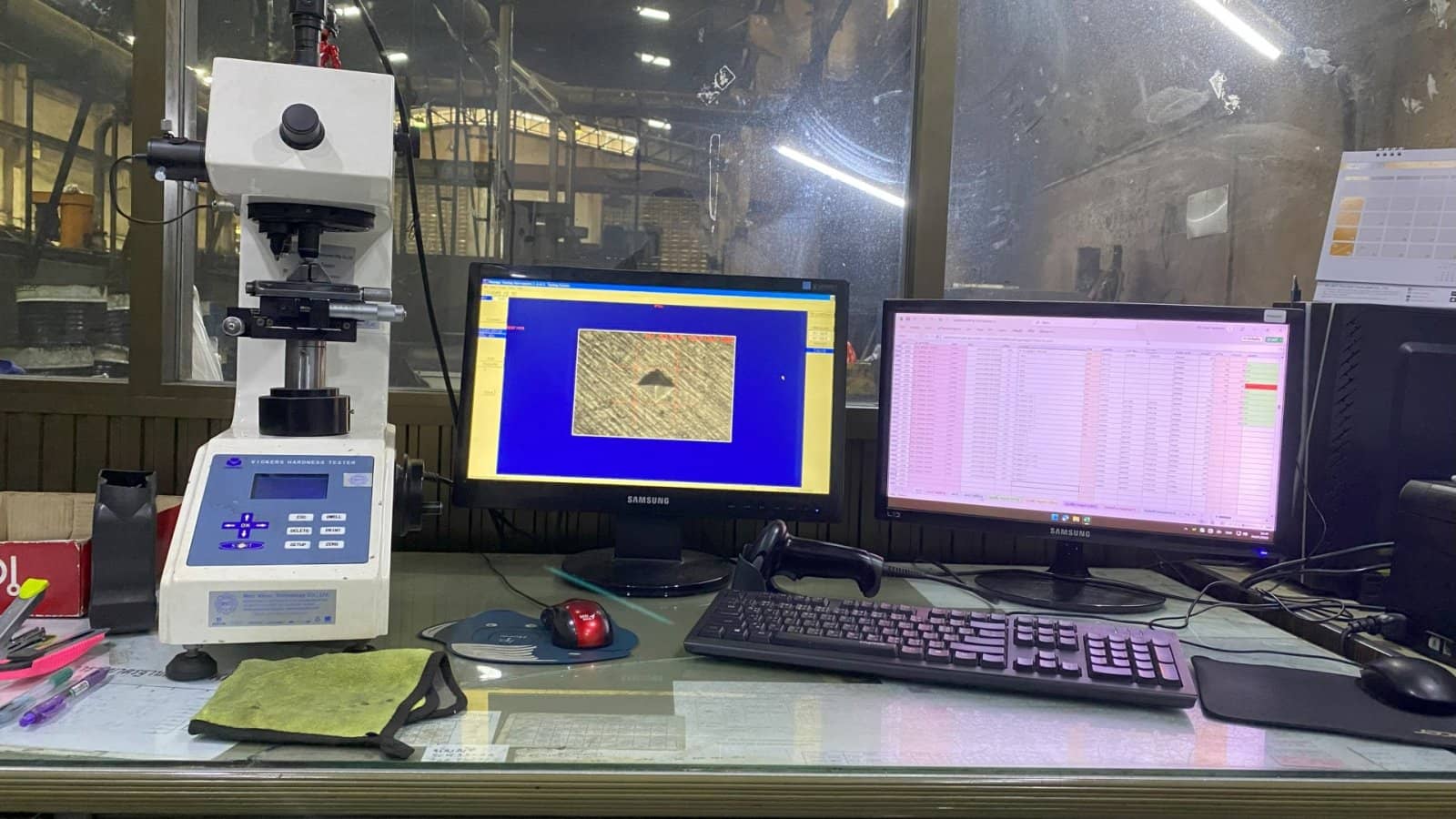
Stated plainly so you can compare: the only certification V.S. Heat Treatment holds is ISO 9001:2015. We do not claim IATF 16949, NADCAP or laboratory accreditation. Our laboratory is in-house (Vickers, Rockwell, XRF thickness, a salt-spray cabinet run along the lines of ASTM B117, microstructure examination) and the reports it issues are in-house reports. If your specification needs an accredited third-party result, tell us and we will be straight with you about how we would handle it.
Our scope is small fasteners in bulk only — screws, nuts, bolts, washers, pins, springs, anchor bolts. If your part is a large component, we are the wrong supplier and we will say so. Plant capacity is 2,000 tons per month, and our zinc plating has used a Cr3+ system since 2020.
We do not publish a price list, because price depends on the part, the volume, the finish and the reports required. What we do commit to is replying to a quote within 24 hours — and answering honestly about what we can and cannot do, before you spend time on a trial lot.
FAQ
What documents should I ask a plating supplier for?+
The quality-system certificate with a scope that matches the processes and the site, a sample test report in the production format, calibration evidence for the instruments that produce your numbers, Cr(VI)-free / RoHS / REACH declarations, and examples of process control records such as bath analysis and bake records.
What should a trial lot prove?+
That the production process works — not that a hand-finished sample can be made. Thickness at both the specified and worst-case locations, thread fit after coating by gauge, consistency when sampled from the front, middle and back of the load, bake records with times, and the report in its real production format.
Is ISO 9001 enough on its own?+
It evidences an audited quality management system. It does not by itself evidence a specific test capability or any sector approval. Read the certificate scope, then verify the process controls that matter for your particular part.
Why do quotes from different suppliers vary so much?+
Usually because they are answering different specifications — thickness, measuring location, passivate type, bake requirement and reporting all move the price. Issue one written specification to everyone and require the same evidence, and the numbers become comparable.
What languages can you handle for foreign factories?+
V.S. Heat Treatment supports Thai, English, Japanese, Chinese and Korean — so specs are communicated precisely.
Standards and references
Free Engineering Tools
- Hardness Converter HRC ↔ HV ↔ HB
- Which Steel Grades Harden — and How Far
- Fastener Weight: pcs ↔ kg
- Finishing Specification Builder for Purchasing and QC
- Salt Spray Test Plan Builder
- Coating thickness → thread fit (GO/NO-GO)
- Hydrogen Embrittlement — is baking required?
- Bolt Tightening Torque & Proof Load
- Thread Engagement Length
- Bolt Size Estimator (from load)
- Bolt Property Class — Mechanical Properties (ISO 898-1)
What this article covers at our plant
Related comparison guides
- Zinc plating vs Dacromet / zinc flakeZinc plating vs Dacromet: which coating for screws and bolts?
- Black oxide vs PhosphateBlack oxide vs phosphate: which finish for screws, nuts and bolts?
- Electroplated zinc vs Hot-dip galvanizingZinc plating vs hot-dip galvanizing: which one does your fastener need?
- Zinc plating vs Zinc-nickelZinc plating vs zinc-nickel: when is the upgrade worth paying for?
- Barrel plating vs Rack platingBarrel plating vs rack plating: how small fasteners are actually plated
- Zinc phosphate vs Manganese phosphateZinc phosphate vs manganese phosphate: match the coating to the job it does
Technical content review
Reviewed by the V.S. Heat Treatment QA and production team—heat-treatment and finishing operations since 1994 under an ISO 9001:2015 quality system.
View evidence and report format