What microstructure is
Microstructure is the arrangement of phases and grains inside a metal, visible under a microscope after polishing and etching — it is what sets a part’s hardness, toughness and wear resistance.
In steel, the main phases come from how much carbon it holds and how it is heated and cooled.
The main phases in steel
- Ferrite — iron with little dissolved carbon; soft and ductile.
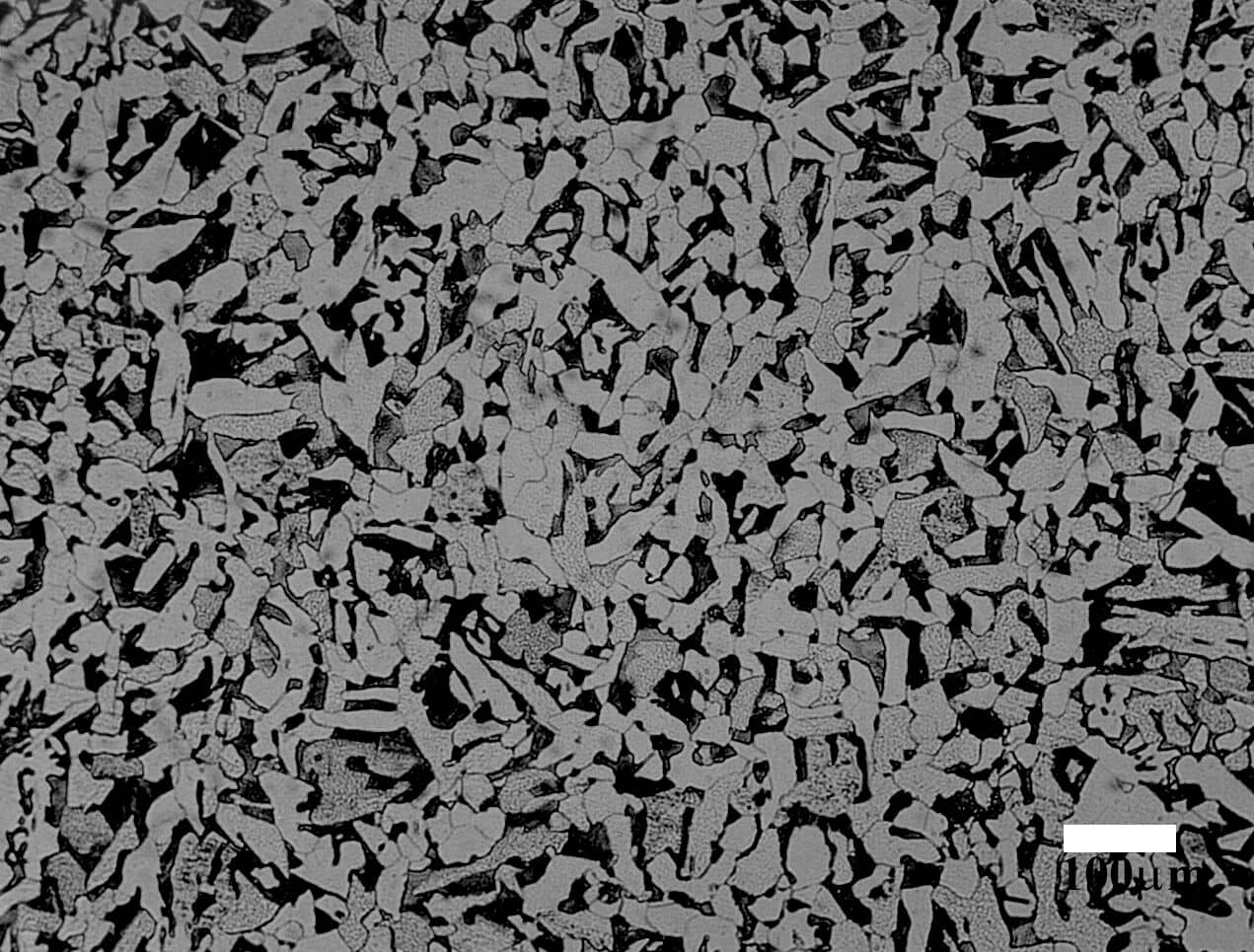
- Pearlite — alternating layers of ferrite + cementite; medium hardness (shown in the photo).
- Austenite — forms at high temperature (~800–900°C) and dissolves a lot of carbon; the starting point for hardening.
- Martensite — forms on rapid quenching from austenite; very hard but brittle = the source of hardness.
- Bainite — a tough/hard balance, formed at intermediate cooling rates.
Why metallurgy matters for hardening
Hardening transforms the microstructure into martensite, then tempering reduces brittleness — control the phases and you control quality.
Microstructure analysis in the lab confirms real martensite (not false hardness) and checks case depth and surface decarburization.
FAQ
Why look at microstructure?+
To confirm real martensite formed, measure case depth, and find the cause of failures — the heart of heat-treatment QC.
What do ferrite and pearlite look like in a micrograph?+
A real micrograph of low-carbon steel showing ferrite (light) and pearlite (dark); the scale bar is 100 µm.
Can V.S. Heat Treatment analyze microstructure?+
Yes — our in-house lab checks microstructure, hardness and coating thickness on every lot.
Free Engineering Tools
- Hardness Converter HRC ↔ HV ↔ HB
- Which Steel Grades Harden — and How Far
- Fastener Weight: pcs ↔ kg
- Finishing Specification Builder for Purchasing and QC
- Salt Spray Test Plan Builder
- Coating thickness → thread fit (GO/NO-GO)
- Hydrogen Embrittlement — is baking required?
- Bolt Tightening Torque & Proof Load
- Thread Engagement Length
- Bolt Size Estimator (from load)
- Bolt Property Class — Mechanical Properties (ISO 898-1)
What this article covers at our plant
Related comparison guides
- S45C vs SCM440S45C vs SCM440: which steel should you harden?
- Annealing vs Tempering vs NormalizingAnnealing vs tempering vs normalizing: which one does your part need?
- SCM435 vs SCM440SCM435 vs SCM440: one alloy step apart, and it shows
- Case hardening vs Through hardeningCase hardening vs through hardening: which one for screws and bolts?
Technical content review
Reviewed by the V.S. Heat Treatment QA and production team—heat-treatment and finishing operations since 1994 under an ISO 9001:2015 quality system.
View evidence and report format