The main hardening methods
There are three main approaches, depending on whether you need the part hard "all the way through" or "only at the surface":
- Through hardening — hard throughout; for medium-to-high carbon steel such as S45C, SCM440; suits bolts and springs.
- Case hardening / carburizing — a hard surface with a tough core; for low-carbon steel; suits parts that need surface wear resistance without being brittle.
- Induction hardening — localized hardening by induction heating; suits specific surface areas.
How to choose
Look at three things:
- Material — low carbon → case hardening; medium-to-high carbon → through hardening.
- Application — surface wear plus impact → hard case, tough core; uniform hardness → through hardening.
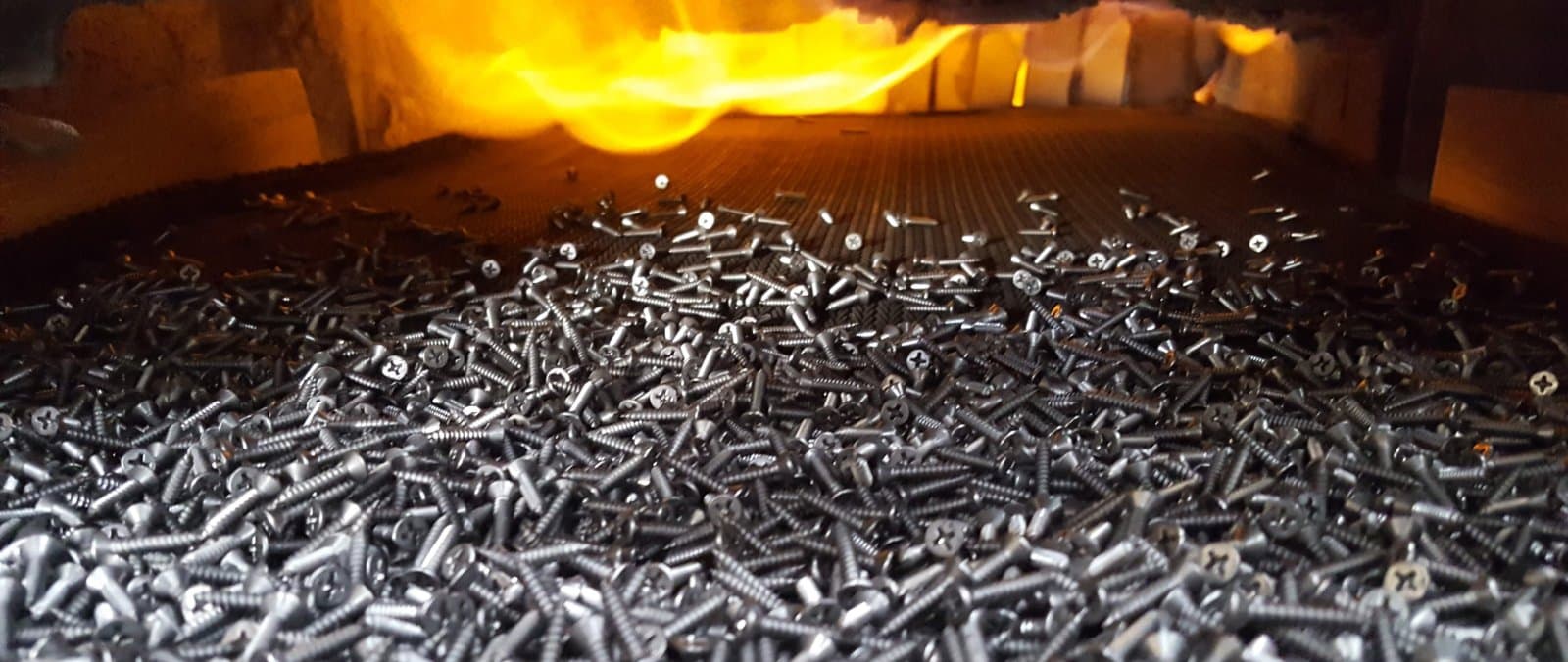
- Shape and quantity — high-volume small parts (screws, nuts) → continuous mesh-belt furnace for consistency.
Small parts (screws, nuts, bolts): which to choose
High-volume small parts are usually run in a continuous mesh-belt furnace, which holds temperature and gas atmosphere consistently.
Hardness follows the bolt grade (e.g. 8.8, 10.9, 12.9). We set the method and cycle to reach your HRC and test every lot with a certificate.
Order or get advice
If you are not sure which method to use, send a photo or sample with the material and how the part is used. Our engineers will recommend the right method and quote within 24 business hours.
FAQ
What is the difference between through and case hardening?+
Through = hard throughout (higher-carbon steel); case = hard surface with a tough core (low-carbon steel with carbon added at the surface).
Which method suits screws and nuts?+
It depends on the grade and material. Most are run in a continuous furnace; we set the method to reach the hardness for the grade.
Can you choose if I do not know the material?+
Send a sample to test — we check the material and recommend the right method.
How do I get advice and a price?+
Send a photo or sample with how the part is used, and we reply with a quote within 24 business hours.
Free Engineering Tools
- Hardness Converter HRC ↔ HV ↔ HB
- Which Steel Grades Harden — and How Far
- Fastener Weight: pcs ↔ kg
- Finishing Specification Builder for Purchasing and QC
- Salt Spray Test Plan Builder
- Coating thickness → thread fit (GO/NO-GO)
- Hydrogen Embrittlement — is baking required?
- Bolt Tightening Torque & Proof Load
- Thread Engagement Length
- Bolt Size Estimator (from load)
- Bolt Property Class — Mechanical Properties (ISO 898-1)
What this article covers at our plant
Related comparison guides
- Case hardening vs Through hardeningCase hardening vs through hardening: which one for screws and bolts?
- Annealing vs Tempering vs NormalizingAnnealing vs tempering vs normalizing: which one does your part need?
- Quenching vs TemperingQuenching vs tempering: two halves of one process
- Carburising vs NitridingCarburising vs nitriding: what a screw, nut or bolt actually gets
- Carbonitriding vs CarburizingCarbonitriding vs carburizing: which case-hardening for fasteners?
- S45C vs SCM440S45C vs SCM440: which steel should you harden?
- SCM435 vs SCM440SCM435 vs SCM440: one alloy step apart, and it shows
- Grade 8.8 vs Grade 10.9 vs Grade 12.9Grade 8.8 vs 10.9 vs 12.9 bolts: what actually differs?
- Class 10.9 vs Class 12.9Class 10.9 vs 12.9: what you gain, and what you take on
Technical content review
Reviewed by the V.S. Heat Treatment QA and production team—heat-treatment and finishing operations since 1994 under an ISO 9001:2015 quality system.
View evidence and report format