Answer read from our own grade table
What is HRC, and how does it convert to HV and HB?
Attainable hardness depends on grade and section size. S45C is the most economical carbon steel for small parts; SCM435 and SCM440 add chromium and molybdenum, so they harden further through a thick section and hold it more uniformly. The figures below separate the as-quenched ceiling from the hardness actually specified in service after tempering — two different numbers.
- S45C
- As-quenched ceiling 50–58 HRC · Specified in service 40–55 HRC
- SCM435
- As-quenched ceiling 48–55 HRC · Specified in service 33–44 HRC
- SCM440
- As-quenched ceiling 50–58 HRC · Specified in service 28–48 HRC
- SWCH10B21
- As-quenched ceiling 40–48 HRC · Specified in service 28–40 HRC
The hardness specified in service after tempering is always below the as-quenched ceiling — specify the service range on the order, not the ceiling.
What is HRC?
HRC stands for Rockwell Hardness scale C, the most widely used hardness unit for hardened steel. A 120° diamond cone is pressed into the surface at 150 kgf and the depth of the indent is measured — the shallower the indent, the higher the HRC and the harder the material.
The usable window is roughly 20–65 HRC. Below that the indent is too shallow to read reliably and you should switch to the HRB or HB scale.
Reference values you will meet on screws, nuts and bolts: property class 8.8 sits around 23–34 HRC, class 10.9 around 32–39 HRC and class 12.9 around 39–44 HRC. Wear parts such as small bearings or spring washers run much higher, at 58–64 HRC.
HV (Vickers) and HB (Brinell) measure the same property but with a different indenter and load, so they produce a different set of numbers. They convert approximately — see the table below.
Hardness correlates with wear resistance and tensile strength, which is why it is the number customers use to accept hardened parts. But harder also means more brittle, so real drawings specify a *range*, never "as hard as possible".
Quick HRC ↔ HV ↔ HB conversion
Per ASTM E140 / ISO 18265 for non-austenitic steel. The last column is approximate tensile strength.
- 20 HRC = 238 HV = 226 HB ≈ 760 MPa
- 25 HRC = 266 HV = 253 HB ≈ 850 MPa
- 30 HRC = 302 HV = 286 HB ≈ 965 MPa
- 35 HRC = 345 HV = 327 HB ≈ 1,125 MPa
- 40 HRC = 392 HV = 371 HB ≈ 1,290 MPa
- 45 HRC = 446 HV = 421 HB ≈ 1,455 MPa
- 50 HRC = 513 HV = 481 HB ≈ 1,630 MPa
- 55 HRC = 595 HV = 560 HB ≈ 1,810 MPa
- 60 HRC = 697 HV = 654 HB — above the range where the standards still correlate tensile strength
- 64 HRC = 800 HV = 722 HB — the top of the table
Two cautions: these hold for non-austenitic steel only (they do not apply to SUS304), and they are estimates that should not replace a real measurement on precision work.
For values between these rows, our hardness conversion calculator carries the full 63-row table.
Common scales
- HRC (Rockwell C) — the most common for hardened steel; fast and easy over 20–65 HRC; used on screws, nuts and bolts.
- HV (Vickers) — a diamond pyramid indenter measures from very thin surfaces to very hard parts; ideal for case-depth profiling.
- HB (Brinell) — a hard ball on softer/medium material leaves a large mark; suited to castings and raw steel.
Conversion and cautions
Approximate conversion tables exist (e.g. ASTM E140), but they are estimates and should not replace real measurement on precision work.
Watch out: plated surfaces, decarburized skins or parts that are too thin can skew readings. Prepare the surface and pick the right scale.
Hardness certificates
Good hardening comes with a test report stating actual hardness, number of points measured and accepted limits.
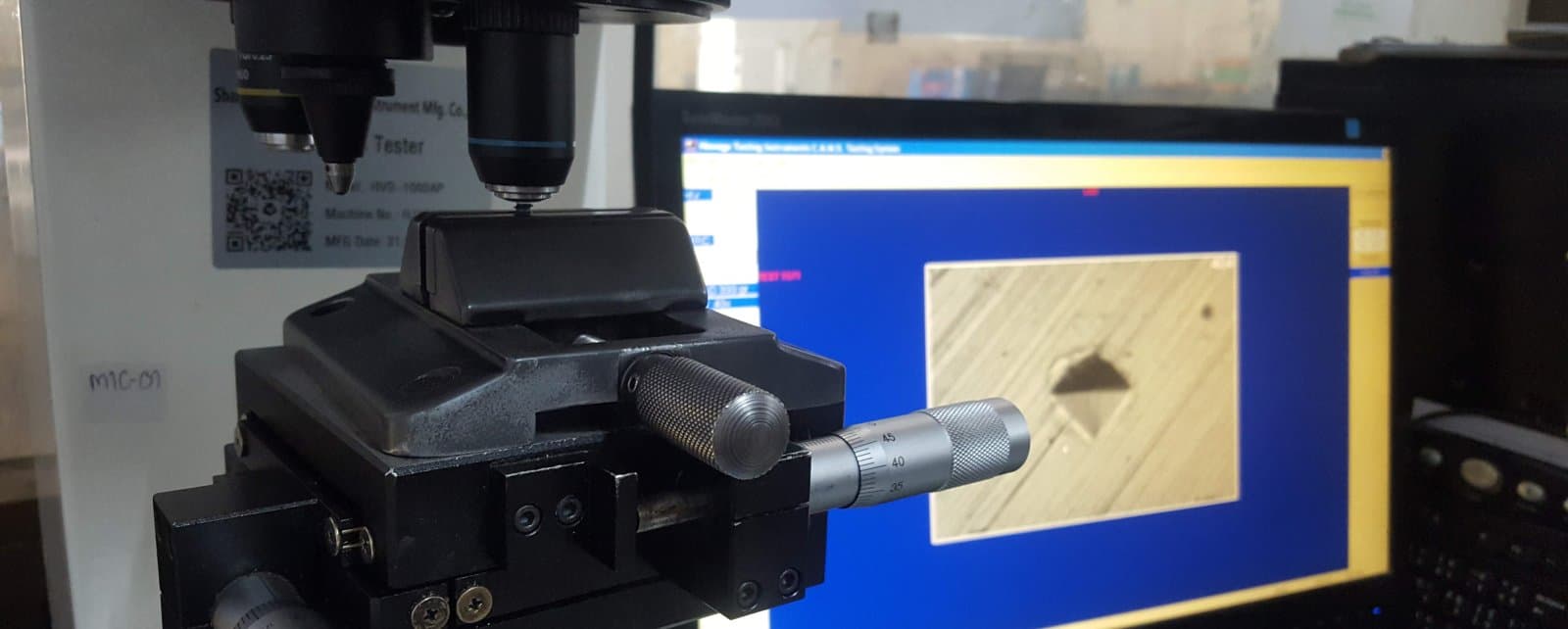
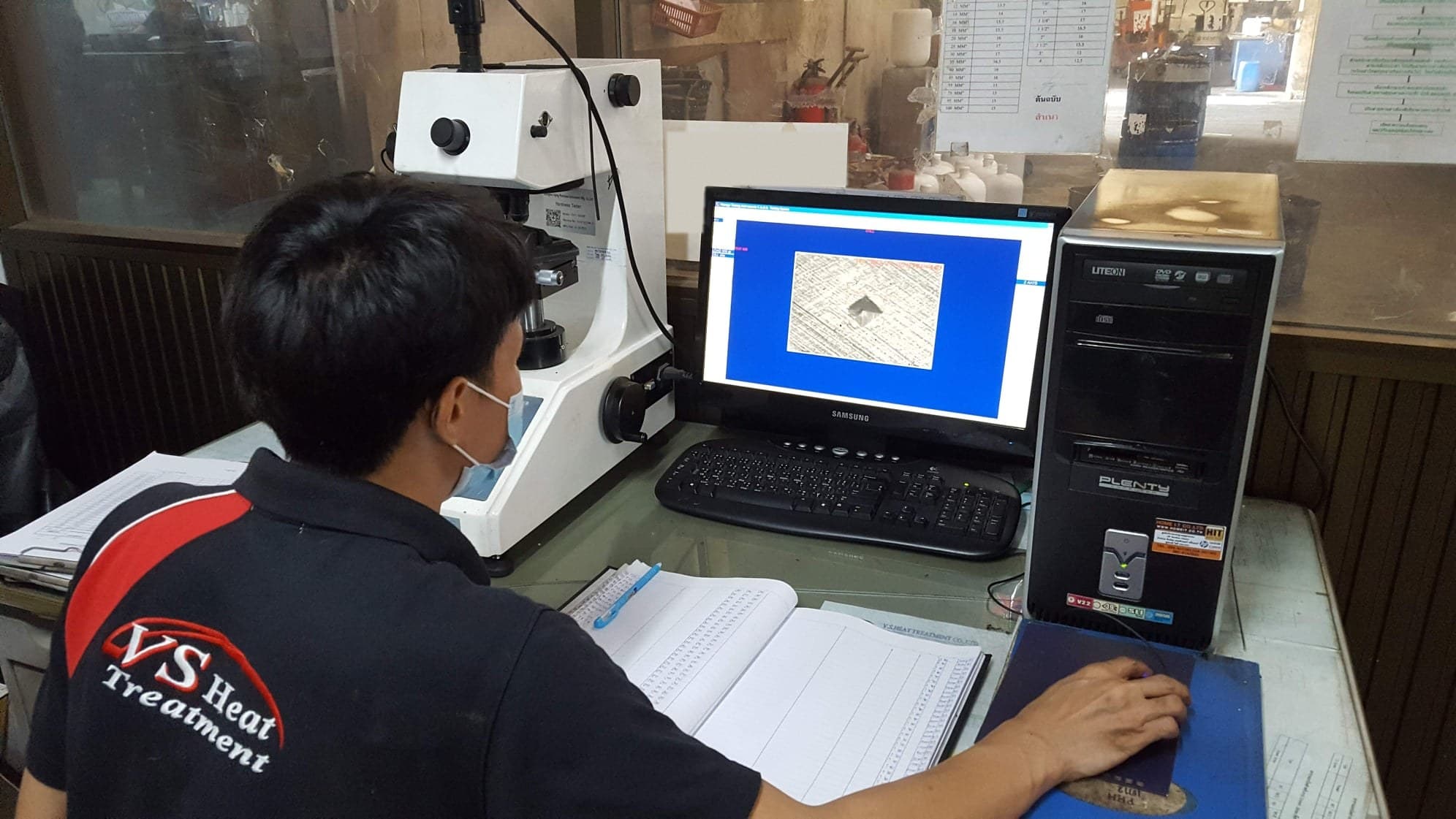
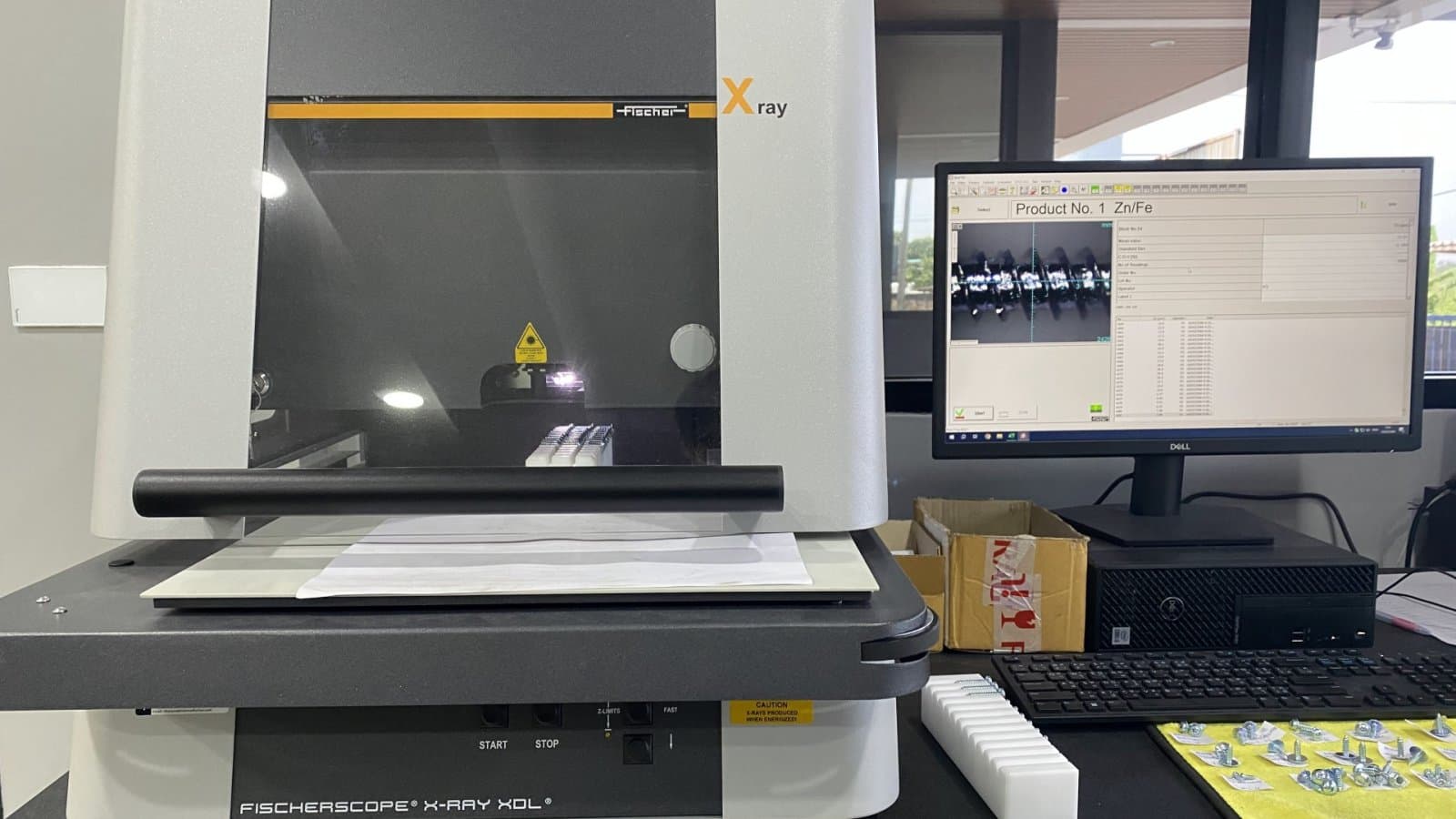
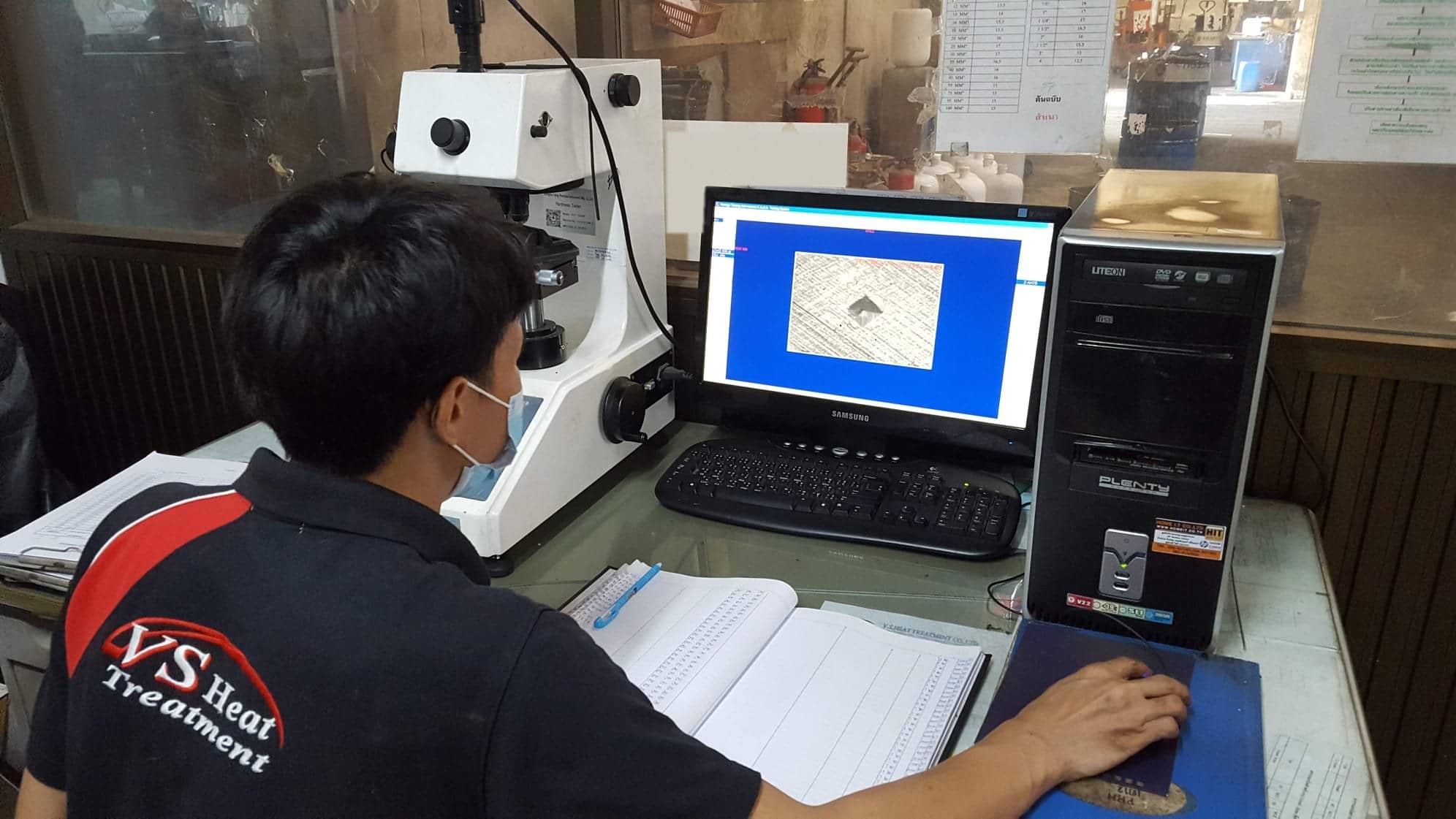
The V.S. Heat Treatment lab uses a Vickers Hardness Test (HV) — a diamond pyramid indenter read under a microscope for high precision — plus an X-ray coating-thickness gauge resolving down to 0.3 mm per point, and issues a report with every lot under ISO 9001:2015.
FAQ
What does HRC stand for?+
Rockwell Hardness scale C — the most common hardness unit for hardened steel. A 120° diamond cone is pressed in at 150 kgf and the indent depth is read. It is usable from roughly 20 to 65 HRC.
How many HRC counts as hard?+
It depends on the job. A class 10.9 bolt at 32–39 HRC is already on spec, while a wear part such as a small bearing needs 58–64 HRC. Specifying more hardness than the part needs simply makes it brittle.
How do I convert 1 HRC to HV?+
There is no fixed ratio — the scales diverge as they rise. 40 HRC is 392 HV but 50 HRC is 513 HV, so the gap widens at the top. Use the table above or a converter rather than multiplying.
How hard is grade 10.9?+
Typically around 32–39 HRC, with the real spec set by ISO 898-1 for that grade.
HRC vs HV?+
HRC is fast for general work; HV is finer and better for thin surfaces and case depth, because its much lighter load does not punch through the hardened case.
Why do repeat readings on the same spot disagree?+
The usual causes are a surface that is not flat enough, a part thin enough for the anvil to matter, a plated or decarburized skin, and measuring too close to an edge. Surface preparation and scale choice matter as much as the tester itself.
Free Engineering Tools
- Hardness Converter HRC ↔ HV ↔ HB
- Which Steel Grades Harden — and How Far
- Fastener Weight: pcs ↔ kg
- Finishing Specification Builder for Purchasing and QC
- Salt Spray Test Plan Builder
- Coating thickness → thread fit (GO/NO-GO)
- Hydrogen Embrittlement — is baking required?
- Bolt Tightening Torque & Proof Load
- Thread Engagement Length
- Bolt Size Estimator (from load)
- Bolt Property Class — Mechanical Properties (ISO 898-1)
What this article covers at our plant
Related comparison guides
- Zinc plating vs Dacromet / zinc flakeZinc plating vs Dacromet: which coating for screws and bolts?
- Grade 8.8 vs Grade 10.9 vs Grade 12.9Grade 8.8 vs 10.9 vs 12.9 bolts: what actually differs?
- Class 10.9 vs Class 12.9Class 10.9 vs 12.9: what you gain, and what you take on
- Electroplated zinc vs Hot-dip galvanizingZinc plating vs hot-dip galvanizing: which one does your fastener need?
Technical content review
Reviewed by the V.S. Heat Treatment QA and production team—heat-treatment and finishing operations since 1994 under an ISO 9001:2015 quality system.
View evidence and report format