Why parts distort
Distortion comes from two forces: thermal stress (sections cooling unevenly) and the phase change from austenite to martensite, which expands in volume.
Thin, long or asymmetric shapes warp most easily because heat leaves the part unevenly.
Residual stress locked in by prior forming or machining is “released” as warping once the part is heated.
How we reduce distortion
- Stress-relieve before hardening to release forming stresses.
- Heat uniformly and slowly enough to limit internal temperature gradients.
- Choose the right quenchant—oil or polymer instead of water—to soften thermal shock.
- Use jigs/fixtures or press-quenching for flat parts that must stay flat.
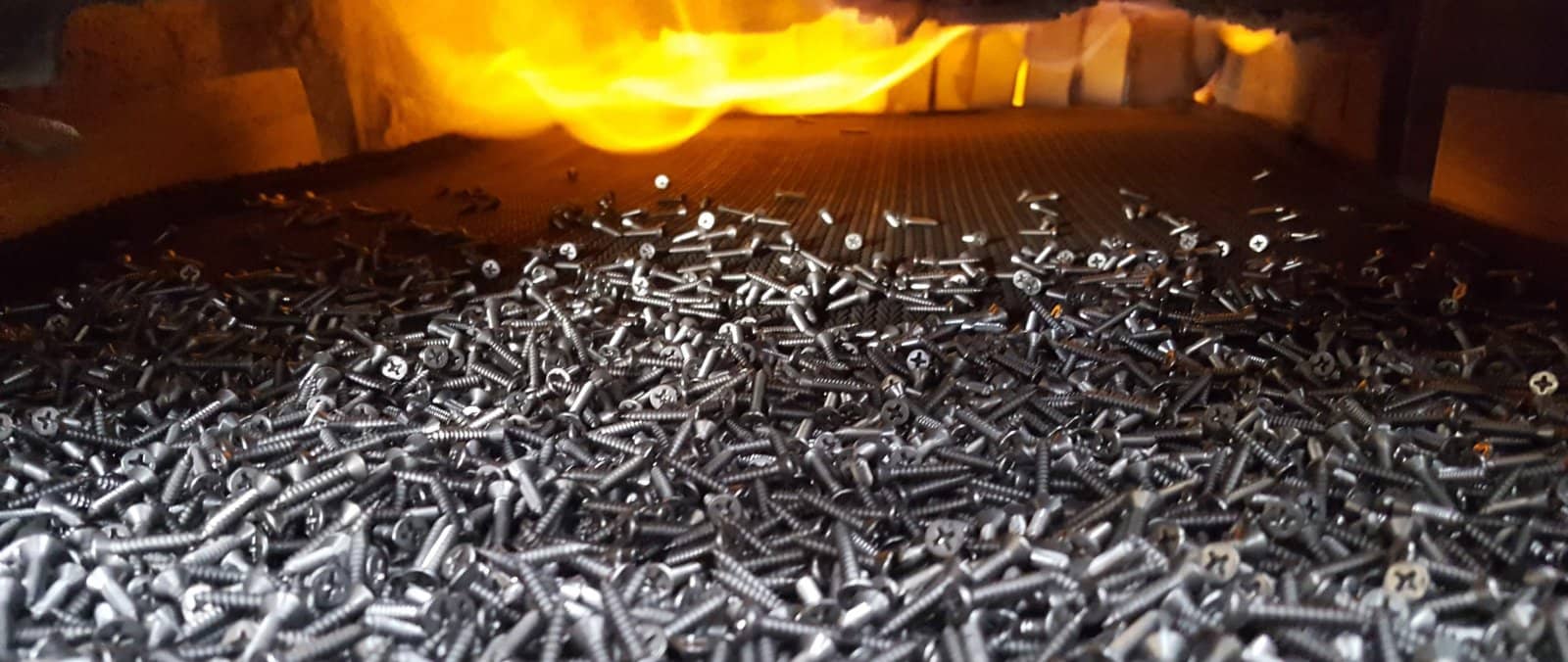
- Lay parts on the belt/tray so they do not pile or overlap.
What if a part already warped
Slightly warped parts can sometimes be straightened while still warm after tempering—carefully, to avoid cracking.
For tight-tolerance work, leave a machining allowance and grind/turn to size after hardening.
The best fix is designing the process together up front; we assess it from your geometry and required tolerances.
FAQ
How much do dimensions change?+
It depends on grade, geometry and quench method—usually small, a fraction of a millimetre. Tight-tolerance parts should allow stock for post-grinding.
Can you straighten parts after hardening?+
Sometimes, especially while warm, but there is a crack risk. Planning an allowance up front is safer.
How is distortion controlled in bulk fastener lots?+
With a belt furnace for uniform temperature, controlled quenching, and dimensional sampling every lot.
Free Engineering Tools
- Hardness Converter HRC ↔ HV ↔ HB
- Which Steel Grades Harden — and How Far
- Fastener Weight: pcs ↔ kg
- Finishing Specification Builder for Purchasing and QC
- Salt Spray Test Plan Builder
- Coating thickness → thread fit (GO/NO-GO)
- Hydrogen Embrittlement — is baking required?
- Bolt Tightening Torque & Proof Load
- Thread Engagement Length
- Bolt Size Estimator (from load)
- Bolt Property Class — Mechanical Properties (ISO 898-1)
What this article covers at our plant
Related comparison guides
- Case hardening vs Through hardeningCase hardening vs through hardening: which one for screws and bolts?
- Annealing vs Tempering vs NormalizingAnnealing vs tempering vs normalizing: which one does your part need?
- Quenching vs TemperingQuenching vs tempering: two halves of one process
- Carburising vs NitridingCarburising vs nitriding: what a screw, nut or bolt actually gets
- Carbonitriding vs CarburizingCarbonitriding vs carburizing: which case-hardening for fasteners?
- S45C vs SCM440S45C vs SCM440: which steel should you harden?
- SCM435 vs SCM440SCM435 vs SCM440: one alloy step apart, and it shows
- Grade 8.8 vs Grade 10.9 vs Grade 12.9Grade 8.8 vs 10.9 vs 12.9 bolts: what actually differs?
- Class 10.9 vs Class 12.9Class 10.9 vs 12.9: what you gain, and what you take on
Technical content review
Reviewed by the V.S. Heat Treatment QA and production team—heat-treatment and finishing operations since 1994 under an ISO 9001:2015 quality system.
View evidence and report format