Published on February 8, 2026 • 5 min read
Heat Treatment 101: choosing the right process
Hardening, tempering, annealing, normalizing — what each heat-treatment process actually does, and how to choose the right one for your steel grade and application.
Heat treatment is not one process but a family of them. Each uses controlled heating and cooling to change steel's internal structure — and therefore its hardness, toughness and machinability — without changing the part's shape. Choosing the right one starts with two questions: what steel grade is the part, and how will it be used?
Hardening (quenching) is the step that makes steel hard. The part is heated until its structure becomes austenite, then cooled rapidly so the carbon is trapped and a very hard phase called martensite forms. Straight after quenching the part is hard but brittle — too brittle to use as-is.
Tempering always follows hardening. The part is reheated to a moderate temperature (roughly 150–650°C) to relieve brittleness and restore toughness, trading a little hardness for a usable balance. The tempering temperature sets the final hardness: a low temper keeps it very hard, a high temper makes it tougher.
Annealing does the opposite of hardening. The steel is heated and then cooled very slowly, usually in the furnace, to make it as soft as possible — easier to machine or form, with internal stresses relieved. It is often used before further machining, or on steel that has become too hard to work.
Normalizing sits in between. The steel is heated and cooled in air, which refines the grain and gives a uniform, slightly stronger structure than annealing. It is commonly used to even out a part before final hardening so the results are consistent.
Case hardening is for low-carbon steel that cannot be hardened right through. Carbon is added to the surface (carburizing) or only the surface is heated (induction), giving a hard, wear-resistant skin over a tough core — ideal for parts that must resist wear yet survive impact.
Which to choose? A bolt that must hold torque needs hardening and tempering. A part that will be machined further needs annealing first. A shaft that wears at the surface but takes shock needs case hardening. Grade matters too: S45C and SCM435/440 through-harden well, while low-carbon grades need a case-hardening route.
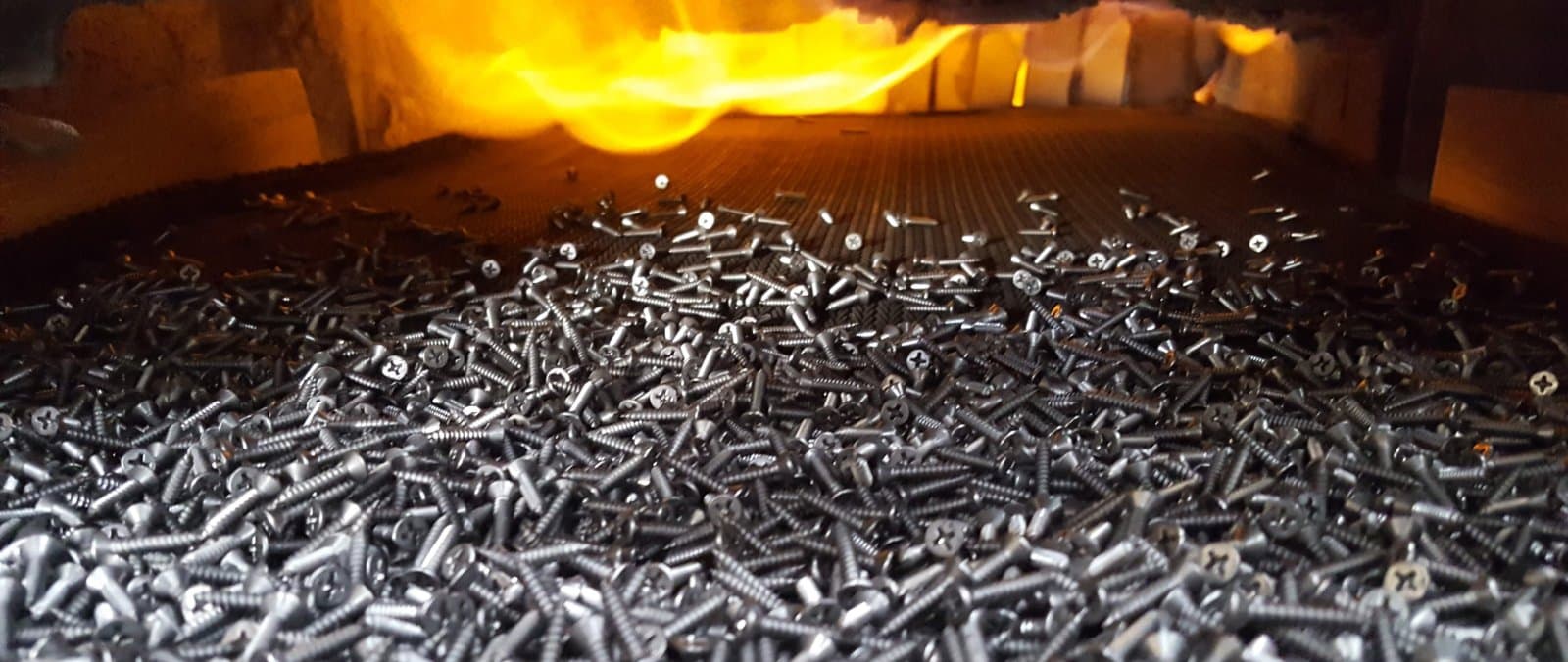
Getting this right is the difference between a part that lasts and one that strips, cracks or wears out early. V.S. Heat Treatment runs hardening, tempering, annealing, normalizing and case hardening on a controlled-atmosphere mesh-belt furnace, with hardness verified per lot. Not sure which process your part needs? Call +66 89 391 9662 for a free recommendation.